Tamiya sales and customer service outside of Japan are overseen by a network of local agents.Find your nearest agent

Fukuiraptor and Fukuisaurus : Japanese Dinosaurs

On this page, we give a detailed explanation of Fukuiraptor and Fukuisaurus, which are recreated as static plastic models in our Clic-Loc 1/35 Dinosaur series. The fossils of both dinosaurs were found in the same stratum in Katsuyama city, Fukui prefecture, which is well-known for dinosaur studies and fossil excavations. Experts answer questions such as: what physical features did these dinosaurs have? How was the natural environment at that time? Did Fukuiraptor prey on Fukuisaurus as a carnivore? What is important for excavating or studying fossils? and more. They take us on a trip back to 120 million years ago. With this page and our products, you too can become a dino-expert!

Explanations by Soki Hattori and Takuya Imai, Associate Professors of the Faculty of Dinosaur Paleontology at Fukui Prefectural University
With the cooperation of Dinosaur Institute, Ltd.

Click the questions like "Q. What kind of dinosaurs were Fukuiraptor and Fukuisaurus", and their answers will be displayed.

  • What kind of dinosaurs were Fukuiraptor and Fukuisaurus?

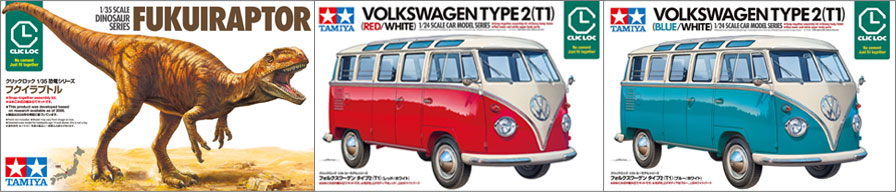
    Fukuiraptor was a bipedal walking carnivorous dinosaur and featured a big head, long hindlegs and a long tail. It is estimated from the type specimen that the living dinosaur was 4.7 meters long and weighed 175 kilograms. But researchers consider it not completely grown because of its immature backbone parts. The lifespan of dinosaurs is measured by cross-section of bones; Fukuiraptor has not been studied in this area, but other relatively close species had a lifespan of about 30 years. Fukuisaurus was a medium-sized herbivorous dinosaur, reaching 5.2m in length. It featured relatively long hindlegs, was bipedal most of the time but could also walk quadrupedally with its auxiliary forelegs. Its beak and teeth were used to feed on ferns effectively.

  • Where do their names come from?

    The scientific name of Fukuiraptor is Fukuiraptor kitadaniensis; in 2000, it was the Japanese first dinosaur to be given a scientific name as a new species. The generic name Fukuiraptor means “thief of Fukui” and kitadaniensis refers to the place where the fossil was found: the Kitadani Formation in Fukui prefecture. The scientific name of Fukuisaurus is Fukuisaurus tetoriensis; the name was given in 2003 and it was the second Japanese dinosaur which was registered as a new species. The specific name tetoriensis comes from the so-called Tetori Group and the whole name would be equivalent to “Lizard of Fukui, found in the Tetori Group”.

  • When and where did these dinosaurs live? What other dinosaurs lived at that time?

    Both dinosaurs lived on the east coast of the Asia continent (Japanese archipelago of today) in the Early Cretaceous about 120 million years ago. Fossils of Fukuititan, Fukuivenator, Koshisaurus and Tyrannomimus were found from the same stratum as Fukuiraptor and Fukuisaurus. These 6 species are thought to have lived at the same time and in the same place.

  • Megaraptora dinosaurs like Fukuiraptor are found also in other parts of the Earth. Are there specific reasons why Fukuiraptor lived in Japan? (Did the same type of dinosaurs live all around the world?)

    Initial Megaraptorans including Fukuiraptor lived in (South)east Asia; at that time, Japan was a part of the Asia continent. Evolved Megaraptorans lived in the later age, the Late Cretaceous, and have been mainly found in Southern America and Australia. So, it is considered that they expanded their habitat from Asia to the Southern Hemisphere rapidly. The origin of Iguanodontians including Fukuisaurus is thought to be in Northern America or Europe, but many points are still unclear. It is also an interesting window into how continents have changed in the long history of Earth.

  • Do Japanese dinosaurs have any typical features?

    No, there were different types of dinosaurs in different times in Japan, so they have no consistent features.

  • How was the natural environment in Japan, when dinosaurs lived?

    Japan was a low fluvial region with many meandering rivers and ponds about 120 million years ago, when Fukuiraptor and Fukuisaurus lived. At that time, the average temperature was some degrees higher than today, and ferns, cycads and conifers were the most common plants. Especially ferns and cycads live in warm regions like tropics and subtropics on the present Earth and can be said to be living fossils that are a carryover from the dinosaur ages.

  • Were there climate variations in this age like hot and cold seasons?

    Japan had wet seasons and dry seasons about 120 million years ago, but no four seasons like today. There was also no cold season with snow.

  • Diorama recreating the Kitadani Formation at that time
  • What did carnivorous Fukuiraptors feed on? Did they eat other dinosaurs like Fukuisaurus?

    They might have eaten Fukuisaurus, but no firm evidence has been found. They may have eaten even bigger prey than themselves, but techniques would have been required for it. Prey are thought to have developed defense mechanisms such as running faster, making a group and evolving bigger bodies.

  • What did herbivorous Fukuisaurus feed on?

    While we cannot be certain, it is thought that they may have fed on ferns, cycads and conifers, which have been found together with fossilized Fukuisaurus remains. They plucked vegetation with jaw tips, then mashed and swallowed it. Therefore, they featured significantly different jaws and teeth to carnivores.

  • Are there any physical differences between carnivorous and herbivorous dinosaurs?

    Yes, particularly in the jaw and teeth. Fukuiraptor’s teeth are flat, as if they have been squashed from the sides, and curve back to a rear point. The jaw hinges at the rear of the teeth, which would have let it open its mouth wide. Fukuisaurus had thicker teeth with ridges at the front which met when it bit together. Its jaw hinged below the teeth, giving it more consistent power that was useful when eating vegetation.

  • Were dinosaurs born from eggs? Did dinosaurs lay multiple eggs and rear young?

    Yes, and dinosaurs could lay multiple eggs on one occasion. The number and whether they reared them depended upon the species.

  • Did dinosaurs live in herds?

    Some dinosaurs did, but not all. There is no evidence at this stage that Fukuiraptor and Fukuisaurus did, but certain fossil records have footprints that suggest some carnivorous dinosaurs lived in herds.

  • We do not know what color dinosaurs were, and it is said that some were even feathered. How do modern-day researchers approach this problem?

    Guesses are often based upon observation of modern-day reptiles and birds. As a rule, animals tend not to stand out in their habitat, to reduce risk of being spotted, and accordingly colors like dull browns and gray are commonly chosen. While the Fukuiraptor model is a relatively light color, we believe that this would be relatively well camouflaged in a typical diorama with reddish-brown soil. However, we see evidence in modern-day birds of vivid colors to attract mates or threaten rivals, and dinosaurs may also have displayed such behavior; hence we cannot discount the possibility of colorful dinosaurs. At present there is no evidence that Fukuiraptor or Fukuisaurus were feathered.

  • Has our image of Fukuiraptor and Fukuisaurus changed as a result of continuing research?

    Fukuiraptor’s elbow joints were re-considered, and its hands are now thought to have faced inward rather than downward, as shown in the images below. The discovery of a fossilized Fukuisaurus skull led to a rethink of its head as a slightly longer shape. New evidence often leads to more refined theory, and that is how we improve our knowledge of dinosaurs.

  • There are conflicting opinions regarding Fukuiraptor’s classification. Is it likely to change in the future?

    The classification of the whole megaraptora genus is still subject to lively debate, and if more definite characteristics emerge, it is quite possible that it may change. As it is an early megaraptora, any advancements in our knowledge of Fukuiraptor could prove the key to greater understanding of megaraptora.

  • Velociraptor and Fukuiraptor (both Tamiya models) are similar despite their different sizes. Were they related?

    Both were carnivores and bipedal theropods with sharp claws. However, their classification inside the Theropoda clade is different: Fukuiraptor belongs to megaraptora, and Velociraptor to the dromaeosauridae, which are slightly closer to birds.

  • Birds are said to be descendants of the dinosaurs. Are any present day animals thought to be descendants of Fukuiraptor or Fukuisaurus?

    While we know that birds trace their lineage back to small, feathered dinosaurs, which species they came from is uncertain. However, we can be sure it was not Fukuiraptor or Fukuisaurus, whose descendants are not alive today. Nevertheless, dinosaur research and classification can provide a fascinating insight into evolution and how creatures developed into their present form.

  • Why is Fukui Prefecture such a hotbed of dinosaur fossils and research?

    The Northeastern part of Fukui is home to the Tetori Group, a rock layer that was originally deep in the earth but became exposed along with its fossils after repeated elevations of the Earth’s crust and was then eroded by rivers. The discovery of such significant dinosaur and vegetation fossils in this area naturally led to the development of research infrastructure.

  • How are dinosaur fossils excavated?

    That depends largely upon the site, but in Fukui excavators and the like are used to remove larger blocks of rock, which are then worked on with smaller tools like hammers and chisels.

  • How is a dinosaur’s form recreated from the discovery of individual bones? Are there any particular difficulties that you face?

    The critical point is determining the species from the fossilized bones. Once that has been achieved, we can look at near relatives to help us recreate the skeleton and imagine the shape of parts we have not yet found. Fleshing out the skeleton with muscle mass is done with reference to modern-day relatives such as birds and crocodiles.

  • Real Fukuiraptor fossil
  • In pictures and illustrations, how do you recreate parts of the dinosaur that are not visible on the skeleton, similar to a lion’s mane or an elephant’s trunk?

    In the case of the skull, mammals have highly developed facial musculature, including the trunk in the case of the elephant, which of course is not visible when only the skull is left. Reptiles (including dinosaurs) do not have such facial musculature, hence their head shape follows that of their skull. When it comes to the body, there is much less deviation in shape between skeleton and muscle (for both mammals and reptiles). Therefore, we can estimate with a certain amount of accuracy a dinosaur’s living form. While this does not extend to fur or feathers, the discovery of some fossils with evidence of feathers is a helpful hint.

  • What is a researcher’s reaction when they uncover a fossilized find?

    The first step is to identify what part of which species of dinosaur it is from. Then we want to identify and secure any fragile sections in order to be able to transport it safely, and also check for other fragments which might be waiting to be found nearby.

  • Can you pick out some interesting features on the Fukuiraptor and Fukuisaurus models?

    The body balance of Fukuiraptor is interesting – carnivores typically have larger heads, shorter necks and long legs in comparison to their arms, but Fukuiraptor has longer arms; the sharp claws are another distinctive point. Fukuisaurus has a beak-like jaw which it would have used to pluck leaves from vegetation. The beak seems to be much like that of a modern-day bird, and it has a different texture to the surrounding areas of skin.

  • On a slightly different topic, do you think it is possible that in the future, we will have autonomous robots that move like dinosaurs did?

    We know what their skeletons look like, so it would be possible now. However, we have no firm evidence of how they moved, so it may not be accurate movement. Even though our knowledge about dinosaurs is constantly improving, any robot’s movement would merely be an educated guess.

August 7, 2026